If you've hatched chicken eggs before, you have a real head start. The fundamentals are the same: temperature, humidity, turning, and patience. But turkey eggs have their own personality, and going in without knowing the differences is one of the most common reasons a hatch disappoints.
We raise Black Spanish/Standard Bronze mix turkeys here at McGreen Acres, and we hatch in a GQF 1500 series cabinet incubator. What follows is what we've learned and what we'd want you to know before your eggs arrive.
Quick Reference
- Incubation period: 28 days
- Temperature (forced air): 99.5°F
- Humidity, days 1-25: 50-60%
- Humidity, lockdown: 65-70%
- Turning: every 6-8 hours, days 1-25
- Lockdown: day 25-26
- Candle: day 7 and day 14
- Brooder temp at hatch: 95°F, reduce by 5°F per week
Turkey Eggs Take 28 Days, Not 21
This is the first thing to recalibrate if you're coming from chickens. Turkey eggs incubate for 28 days. Lockdown, which for chickens happens around day 18, doesn't begin until day 25 or 26 for turkeys. The entire schedule shifts, and if you run it like a chicken hatch, you'll pull eggs from the turner too early and raise humidity at the wrong time.
Mark your calendar from the day you set the eggs. Know your lockdown date before you ever close the incubator lid.
Your Incubator Setup Matters More Than You Think
Turner trays: Standard chicken turner rails likely won't hold turkey eggs securely. Turkey eggs are noticeably larger and heavier, and an egg that tips sideways or gets stuck mid-turn is an egg that may not develop properly. Before you set anything, confirm your turner is fitted for turkey or large eggs. The GQF 1500 series accommodates turkey eggs with the appropriate turner, and it's worth verifying yours is configured correctly before your eggs arrive. In a pinch, you can use extra large egg cartons on the racks in place of the trays.
Run it first: Your incubator should be sanitized, set up, and running for at least 24 hours before you place any eggs inside. This lets the internal environment stabilize and gives you time to catch any temperature or humidity drift before it costs you a hatch.
Thermometer and hygrometer: Don't rely solely on the incubator's built-in readings, though this can be a good start. Turkey embryos are much more sensitive to environmental changes. For best results, use a separate calibrated thermometer and hygrometer placed at egg level. Cabinet incubators like the GQF can have slight variation between the top and bottom of the cabinet, and knowing your actual conditions matters.
Temperature and Humidity Settings
For forced-air cabinet incubators:
- Temperature: 99.5°F throughout incubation
- Humidity, days 1 through 25: 50-60% relative humidity
- Humidity, lockdown (days 26 through hatch): Raise to 65-70%
Humidity is where most people run into trouble. Turkey embryos are sensitive to swings in either direction during the first week especially, when the nervous system and vascular network are forming. Consistent conditions matter more than perfect conditions. A steady 55% is better than one that bounces between 45% and 65%.
Watch your air cells when you candle. If they're growing too fast, your humidity is too low. If they're barely changing, it's too high. The air cells are your most reliable feedback throughout the hatch.
Egg Handling Before You Set Them
If your eggs are coming from us locally, you're in good shape on freshness. Hatchability declines roughly 2% per day after the eggs are laid, so the fewer days between collection and incubation, the better.
A few things to know before you set:
- Do not refrigerate hatching eggs. Standard refrigerator temperatures are too cold and can damage the embryo.
- Store pointed end down in a cool, stable location around 55-65°F until you're ready to set. Storing at room temperature or higher makes the eggs age much faster.
- Let them reach room temperature before placing them in the incubator. Setting cold eggs into a warm, humid environment can cause condensation, cracking, and early embryo death.
- Do not wash the eggs unless they are heavily soiled. The natural bloom on the shell is a protective barrier against bacteria. A slightly soiled egg is better than a washed one.
If an egg must be cleaned, use water that is at least 10 degrees warmer than the egg itself. Cold water causes the shell to contract and can pull contaminants inward through the pores.
Turning
Turkey eggs need to be turned at least 3 times per day, ideally every 6 to 8 hours, from day 1 through day 25. The GQF cabinet turner handles this automatically once you set it up correctly.
Even with an automatic turner, mark an X on one side and an O on the other, before you set them. Use a soft pencil or crayon, not a marker. The ink in a marker can seep into the pores of the egg. This lets you verify the turner is actually working and that each egg is rotating the full 180 degrees. It takes two minutes and has saved more than a few hatches.
If the embryo isn't turned regularly, it can stick to the shell membrane and die. Don't skip this step manually if your turner ever fails mid-hatch.
If the power goes out: Stay calm. A cabinet incubator with eggs inside holds heat reasonably well for a short outage. Keep the door closed to retain warmth. If the outage is brief, under an hour or two, the hatch can usually recover without significant loss. For outages that stretch longer, drape a heavy blanket over the incubator to slow heat loss and manually turn the eggs by hand every few hours. If you are looking at more than a day without power, find an alternate power source. A generator is warranted at that point. The risk to a full hatch is too significant to wait it out. Once power is restored, let the incubator return to 99.5°F before resuming normal monitoring. Eggs that experienced a temperature drop may hatch a day or two late. Do not write them off early.
What's Happening Inside the Egg
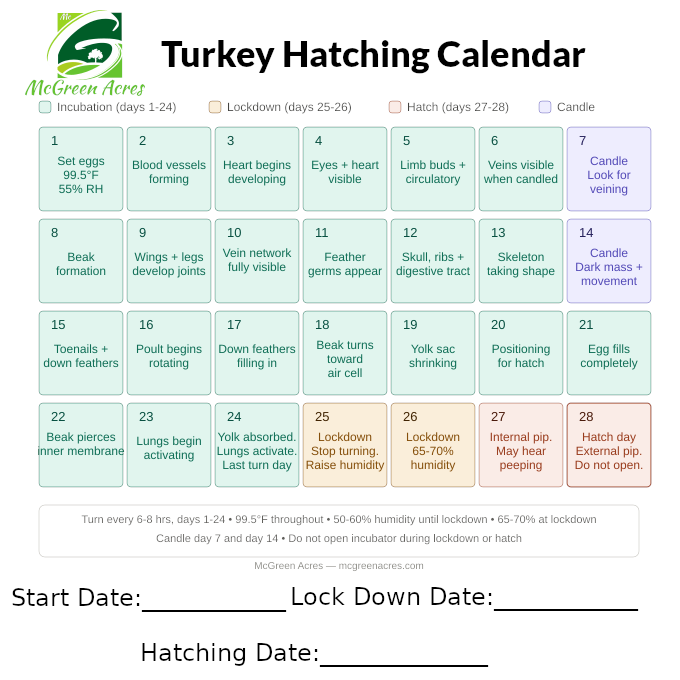
A lot is going on during those 28 days. Here's a general outline of development by stage:
Candling
Candle around day 7 and again around day 14.
At day 7, look for veining and a dark spot indicating the embryo. Clear eggs with no development are likely infertile and should be removed. A rotten egg left in the incubator can explode and contaminate the rest of the hatch.
Turkey eggshells are thicker and more speckled than chicken shells, so you'll need a bright candler and a dark room. Take your time.
At day 14, you should see a larger dark mass with continued vein development. Any eggs that look clear or have stopped developing should come out.
Lockdown
On day 25 or 26, stop turning. If you're using an automatic turner, remove the eggs from the turner rails and lay them on their sides directly on the incubator floor or a hatching tray. Do not stand them upright during lockdown.
Raise humidity to 65-70%. Open the vents fully to ensure adequate airflow. The poults are positioning themselves inside the shell to prepare for hatching, and they need oxygen.
From this point forward, do not open the incubator unless absolutely necessary. Every time the door opens, temperature and humidity drop and have to recover. That recovery time is time your poults don't have.
Hatch Day
Around day 27 or 28, you'll begin to hear peeping from inside the eggs before anything breaks through. That's normal and a good sign. The first break in the shell is called a pip.
After a pip, give the poult time. It can take up to 24 hours from the first pip to a fully hatched poult. Resist the urge to help. The process of pushing out of the shell builds strength the poult will need in its first days. Intervening too early often does more harm than good.
Once poults are out and have dried off in the incubator, move them to a brooder set to 95°F for the first week. Lower the temperature by 5 degrees each week as they feather out. Turkey poults need a starter feed formulated for turkeys or game birds, not standard chick starter.
A Note on Our Turkeys
Our hatching eggs come from our Black Spanish/Standard Bronze mix flock. Both are heritage breeds with strong foraging instincts, good temperament, and a different body structure than commercial Broad Breasted birds. They are not fast growers, but they are healthy, hardy, and capable of natural reproduction.
Heritage turkeys like these follow the standard 28-day incubation timeline. They do not require any special deviation from the settings above.
Ready to Get Started?
Turkey hatching eggs are available now from McGreen Acres. You can order through our online store or reach out to us directly through our contact page with any questions!